
Six centimeters of snow. That’s all it took to ground 140 flights, stop the buses, and turn the Champ de Mars into an impromptu ski slope back in January 2026. Six centimeters barely enough to cover your shoes and a European capital ground to a halt.
So does it snow in Paris? Yes. But there’s an asterisk hanging off that answer, because most winters here give you nothing more than a handful of flakes that vanish before lunch. Below is the real picture: the actual numbers, the storms Parisians still bring up at dinner parties, and what changes around the city Metro include the moment snow starts sticking.
Does It Snow in Paris It Snows, Just Not the Way You’d Think
Does It Snow in Paris? is doing a lot of heavy lifting in that sentence, honestly. On paper, Paris logs anywhere from 2 to 15 snow days a year, and that huge spread exists because a few stray flakes drifting past your window get counted the same way as an actual storm in most official records. When you notice snow you’d actually look up from your coffee for lands closer to 3 to 8 days a winter, mostly clustered between December and March. Real accumulation, the kind that sits on rooftops long enough to photograph, is rarer still. Once every few years, on average. Though Paris has managed it twice in the last two winters, so maybe don’t trust averages too much.
Blame the Atlantic for most of it. Paris sits under an oceanic climate, which means mild, damp air keeps rolling in through winter and keeps temperatures hovering just above freezing more often than not. A lot of what could’ve been snow just falls as cold rain instead. Then the city finishes the job. All that concrete, traffic, and heated apartment blocks throw off enough warmth that snow melts faster downtown than it does twenty minutes outside the ring road.
Your Actual Odds, Month by Month
January and February give you the best shot, though “best” is relative here. Records from Paris-Montsouris, the city’s long-running weather station, lay out a pretty clear trend. Between 1931 and 1960, Paris averaged around 13 snow days a winter, with a mean winter temperature close to 4°C. Fast forward a few decades and that average temperature had crept up to 5.7°C, while snow days dropped to just 7.1. And remember, that number counts everything, including three flakes drifting past a window.
Here’s roughly how the season breaks down:
- December sits right at the edge of the window. Snow’s possible, but it rarely sticks usually just 1 to 2 snow days.
- January is the coldest month of the year in Paris, and the most reliable one for actual snow, at just over 2 days on average.
- February technically edges out January as the snowiest month on record, and it’s produced some of the city’s biggest storms — 2018 included.
- March drops off fast, under a day on average, though it still catches people off guard occasionally.
- November isn’t typical, but it’s not off the table either. Storm Caetano proved that in 2024.
None of this guarantees anything for one specific week in one specific year. Plenty of winters pass with barely a flake. Then one comes along and ends up on the evening news.
How Much Actually Falls
Not much, most years. Here’s what a fairly typical winter looks like, laid out month by month:
| Month | Average Snowfall | Average Snow Days |
|---|---|---|
| December | ~1 cm (0.4 in) | 1–2 days |
| January | ~2–3 cm (1 in) | 2–3 days |
| February | ~2 cm (0.8 in) | 2–3 days |
| March | Under 1 cm | 0–1 days |
Then a real storm rolls through and every one of those numbers stops mattering. February 2018 dropped 12 to 15 cm on the city, with nearby areas seeing closer to 20 cm. January 2026 brought 3 to 5 cm across central Paris and up to 7 cm in parts of the wider region — enough to shut down bus routes and cancel over a hundred flights out of Charles de Gaulle. That’s the gap between an average winter and one person still brought up years later.
The Storms Parisians Still Talk About
Paris doesn’t get snow often enough to have a “normal” storm. What it has instead is a short list of memorable ones, and locals reference them by year the way other cities reference hurricanes.
| Date | What happened |
| March 1946 | Still the record holder. Around 40 cm at Parc Montsouris nothing since has come close. |
| December 1954 | Cold enough, by some accounts, that people crossed the frozen Canal Saint-Martin on foot. |
| February 1956 & January 1963 | Two of the harshest, longest cold spells of the last century. Each dragged on close to three weeks. |
| December 2010 | Around 10 cm fell, and Île-de-France more or less shut down. Record traffic, closed schools, Versailles shut for the day. |
| March 2013 | A late-season storm with totals close to 2010’s. |
| February 2018 | Heaviest snow since 1986. 12–15 cm in the city, over 700 km of traffic jams region-wide. |
| February 2021 | More moderate, but still enough to snarl travel across Île-de-France. |
| November 2024 | Storm Caetano. An unusually early snowfall — 1 to 4 cm across parts of the region. |
| January 5–7, 2026 | The Eiffel Tower, the Louvre, Montmartre — all under 3 to 7 cm. Over 140 flights cancelled, buses paused for hours. |
If you’re trying to gauge your real odds of catching a white Paris, this table tells you more than any seasonal average could. It’s the gap between what’s typical and what people actually remember.
What’s Working Against Paris Here
Three things conspire against Paris, more or less all at once. There’s the Atlantic, feeding in mild, wet air nonstop through winter and never letting temperatures drop low enough for long enough. There’s the city itself, concrete, traffic, and heated apartments radiating enough warmth to melt snow downtown faster than it melts in the suburbs. And there’s elevation: Paris tops out around 130 meters above sea level, which is nothing compared to somewhere like Alsace or the hills around Reims, where the air actually stays cold enough for snow to hang around.
Météo-France’s own 2022 outlook on Parisian winters doesn’t suggest any of this is reversing, either fewer frost days, fewer stretches without a thaw. The general direction points toward less snow, not more. Still, 2026 is proof it isn’t a straight line down. Snow hasn’t disappeared; it’s just turning into more of an event than a season, one of those small facts about Paris that doesn’t make it into most travel guides.
When to Go If You’re Chasing Snow
Mid-January through mid-February gives you the best odds for what that’s worth, since “best odds” here mostly means “still probably not, but maybe.” Early December sits right at the edge of the window. Flakes are possible once temperatures finally settle below freezing late in the month, but real accumulation that early is a long shot. If snow’s more of a nice-to-have than the whole point of your trip, it’s worth reading up on the best time to visit Paris more broadly, since crowd levels and pricing move right along with your snow odds anyway. It’s also worth sketching out a loose Paris itinerary with a few indoor backups built in, so a surprise snow day or a total no-show doesn’t derail the whole trip.
What Actually Changes When It Snows
Even a light dusting throws the city off for a day or two, mostly because Paris just isn’t built to clear snow fast.
The Metro and buses hold up fine underground; it’s the elevated stretches, Line 2 up north and Line 6 near Montparnasse, that slow down or stop once ice builds up on the tracks. Vélib’ bikes are a hard no; cobblestones plus a light dusting equals a skating rink, and nobody needs that on vacation. Walking’s genuinely your best move anyway, and it’s how you’ll get the best photos.
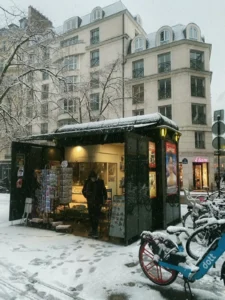
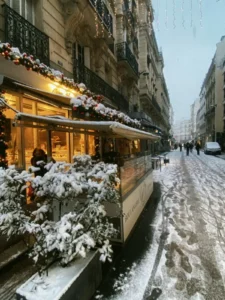
Central Paris is compact enough that most distances are doable on foot. Landmarks sometimes close temporarily as a safety call once accumulation gets heavy, which happened briefly in both 2018 and 2026, so it’s worth checking the official site the morning of if snow’s in the forecast. And flights take the biggest hit, mostly out of CDG and Orly the January 2026 storm alone knocked out well over a hundred of them, so build in some slack if snow’s showing up on your travel day.
Packing for it doesn’t mean packing like you’re headed to Chamonix. A warm, waterproof coat, boots that actually grip, and layers you can add or shed indoors will carry you through nearly anything a Paris winter throws your way. For more on that, our guide to what to pack for Paris covers the winter specifics.
Where People Trip Up
Planning the whole trip around it is probably the biggest one. With only a handful of snow days most winters, treating snow as a sure thing is a good way to end up disappointed. A close second is assuming the Metro won’t be affected at all; mostly it holds up, but not entirely, and the elevated lines are the ones to watch. Wrong shoes trip people up too; slush plus cobblestones ends regular sneakers fast. So does trusting a generic weather app over Météo-France, since local forecasting tends to catch the borderline rain-or-snow calls that international apps miss. And honestly, the last one is just not leaving room to adjust. A surprise snow day is a great excuse to swap an outdoor plan for a museum or a long café sit, and fighting the weather rarely works out in your favor.
Where Paris Looks Best Under Snow
A few spots come up again and again in photos from past storms. Montmartre’s steep streets and staircases turn genuinely picturesque under snow, and yes, people really do bring out sleds on the steeper bits. The Eiffel Tower and Champ de Mars remain the most photographed combination in the city, snow or no snow, but especially with it. Luxembourg Gardens and the Tuileries look like a completely different place once the lawns and fountains are dusted white. And the Seine bridges, Pont Alexandre III especially, give you the classic wide shot everyone’s seen a hundred times and still ends up taking anyway.
If you’d rather skip the crowds, there’s a longer list of hidden gems in Paris worth exploring: plenty of quiet courtyards and side streets photographed just as well in snow, minus the other tourists crowding your frame. And if you’re planning to post the results, a decent set of Paris captions never hurts.
How Paris Measures Up Against Other Cities
| City | Avg. Snow Days/Year | Typical Winter Low |
| Paris | 3–8 | ~1°C |
| London | 10–15 | ~2°C |
| Strasbourg | 20–30 | ~-1°C |
| Amsterdam | 10–20 | ~1°C |
| Vienna | 25–40 | ~-2°C |
If you want snow you can actually count on rather than snow you’re just hoping shows up, Strasbourg a few hours away, often called France’s Christmas capital is a much safer bet than Paris.
Is Climate Change Behind This?
The data leans that way, though it’s not a clean, steady decline. Météo-France’s 2022 projections for Parisian winters point to fewer frost days and fewer cold snaps capable of producing real snow. And yet two of the more notable snow events in recent memory, November 2024 and January 2026, both landed after that projection came out a decent reminder that “rarer on average” doesn’t mean “gone for good.” As of 2026, Paris still gets some form of snow most winters. What’s actually shrinking is how often that snow sticks around long enough to matter.
Conclusion
Snow in Paris is real, but it’s a bonus, not something worth building a whole trip around. Most winters bring a few forgettable flurries and not much else. The kind of snow that actually blankets the city shows up unpredictably sometimes years apart, sometimes twice in two winters, like 2024 and 2026 back to back. If snow’s part of why you’re going, leave room in your plans instead of betting on it. And if it never shows up, Paris in winter still has that quiet, low-light mood that summer just doesn’t have. Check the forecast, pack smart, and let the city decide the rest.
FAQs
How often does it snow in Paris?
Somewhere between 3 and 8 days a year, most of it light flurries that are gone within hours. Real accumulation is rarer sometimes just once every few winters.
How much snow does Paris get in a typical winter?
Not much. A few centimeters total, spread thin from December through March. The city’s biggest storms, like February 2018 and January 2026, brought 3 to 15 cm in a single event, well above the usual.
Does it snow in Paris in November?
Rarely, but it happens. The 2024 Caetano storm was unusual enough to make local news on its own. Don’t plan around it, but don’t rule it out either.
Does it snow in Paris in December?
Sometimes, though it rarely sticks. December’s right at the edge of the season flakes tend to show up only once temperatures settle below freezing later in the month.
Does it snow in Paris in January?
Yes, more reliably than any other month besides February. It’s also the coldest month of the year in the city.
Does it snow in Paris in February?
This is technically the snowiest month on record, and it’s where some of Paris’s biggest storms have landed, 2018 included.
Does snow close the Eiffel Tower?
Sometimes, briefly, if accumulation gets heavy enough to be a safety concern it happened in both 2018 and 2026. Light snow usually doesn’t change anything. It’s worth checking the official site the morning of your visit if there’s a snow forecast.
Is Paris worth visiting in winter if it doesn’t snow?
Yes. Shorter lines, cheaper hotels, and a low, quiet light that changes the whole feel of the city compared to summer. Snow’s a bonus if you get it, not the reason to go.